
Echols County Court Records After Arrest
After an Echols County arrest, three record streams can exist at the same time. The arresting-agency record begins with the Echols County Sheriff's Office. The jail custody record runs through Lowndes County Jail because Echols arrestees are housed there. The court case record is maintained through the Echols courts and, for felony and superior-court criminal matters, the Echols Superior Court Clerk.
The arrest-to-court path is usually arrest, transport and booking, first appearance and bond review, prosecutor review, filing of a charging document, and case indexing by the court. The Southern Judicial Circuit District Attorney handles felony and superior-court prosecution for the circuit that includes Echols County. District Attorney Bradfield M. Shealy's office reviews reports, drafts accusations and indictments, presents cases to grand jury, negotiates pleas, dismisses nonprosecutable cases, and handles trial work. Those prosecutor actions are why the charges in court records after a jail arrest may differ from the charges first seen at booking.
For custody and booking status, use Echols County jail inmate records. For booking-photo questions, use Echols County jail mugshots. The court record is the source for filed charges, docket events, hearings, and outcomes.
Find Echols County Court Records
Echols Superior and Juvenile Court lists the clerk's office at 110 Hwy 94 East in Statenville, with phone 229-559-5642 and office hours Monday-Friday, 8:00 a.m.-4:30 p.m. The official court page says the clerk maintains records and handles criminal court filing and processing. Nora Leigh Rogers is named as Clerk of Superior Court, and Gabriela Gallegos is named as Chief Deputy Clerk. The clerk can help with official file access, but the court materials note that legal advice is outside the clerk's role.
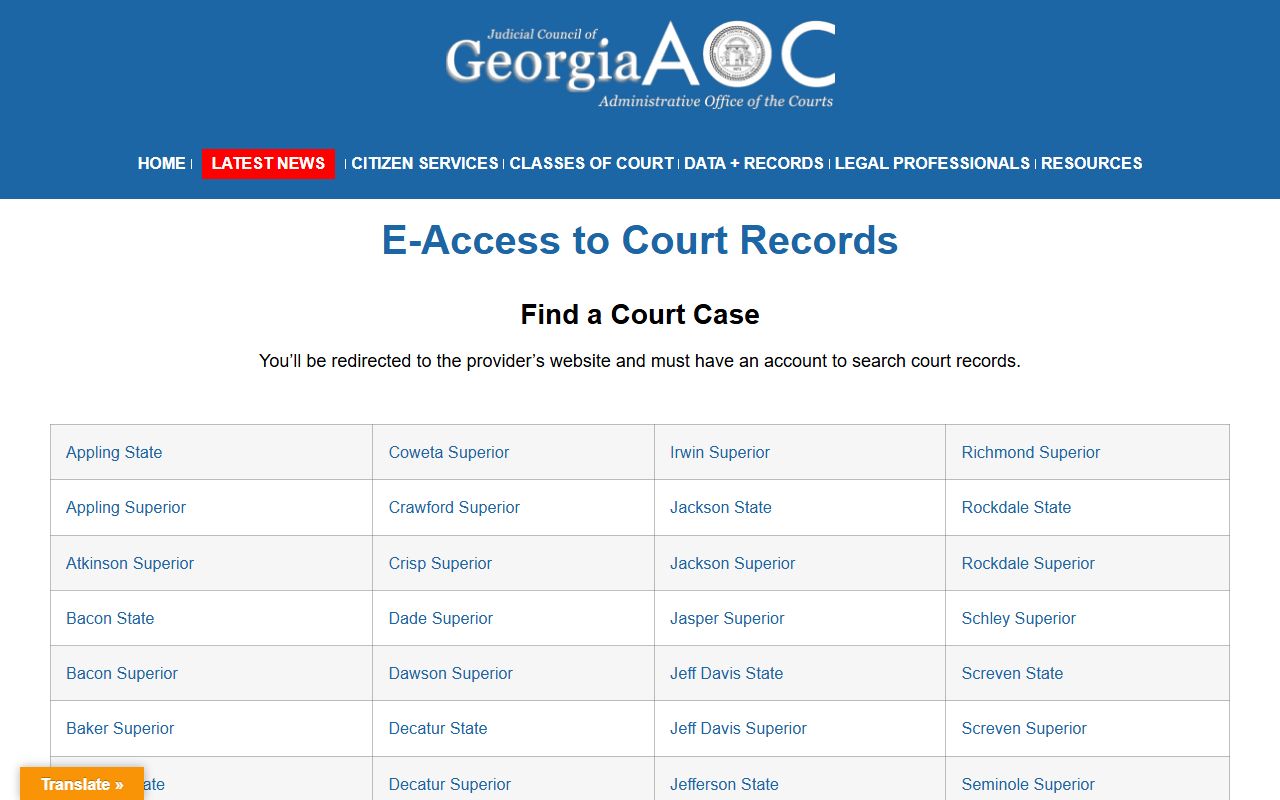
The official Georgia Courts e-access page lists Echols Superior as a participating court and says users are redirected to provider websites and must have an account to search court records. The project image below shows the state e-access route used for Echols court records after an arrest.
Account-based access is useful, but it is not a substitute for the clerk when a user lacks a case number or needs a complete local file.
- Identify the court from the citation, bond paper, warrant, or clerk notice.
- Try Georgia Courts e-access, re:SearchGA, or PeachCourt when the court and provider support the search.
- If the provider requires an exact case number, contact the Echols Superior Court Clerk or Probate/Magistrate Court for the proper local route.
- Read the filed charge list and docket status separately from any jail booking charge.
Echols County Court Search Fields
The court-search field inventory is limited because full e-access and re:SearchGA case views require account access. PeachCourt help material does provide some verified search guidance: case searches use county, court, and exact case number, while filing searches use a Peach number. Available criminal docket items can vary by court.
| Field Label | Type | Required | Notes |
|---|---|---|---|
| Provider account/login | Account requirement | Yes for full search | Georgia Courts says provider access requires an account. |
| County | Dropdown/filter | Required in PeachCourt case search | Select Echols when searching an Echols case. |
| Court | Dropdown/filter | Required in PeachCourt case search | Georgia Courts links Echols Superior to PeachCourt. |
| Case number | Text | Required in PeachCourt case search | Must match the court's exact case-number format. |
| Peach number | Text | Required for filing search | Used under PeachCourt Search > Filings. |
| Party search | Unverified | Unverified | Exact public fields were not verified inside account-based provider access. |
Echols County Arrest Court Routes
Superior Court is the main route for felony and many serious criminal filings. The Southern Judicial Circuit includes Brooks, Colquitt, Echols, Lowndes, and Thomas counties, and the District Attorney's Office is listed in Valdosta with phone 229-671-3268 in the Lowndes County directory. Prosecutor timing explains many search failures. A person can be booked before a formal indictment or accusation appears in a court index.
Probate/Magistrate Court handles traffic and magistrate matters. The Echols Probate and Magistrate page names Judge Carlos L. Rodgers, lists phone 229-559-7526, and gives office hours Monday-Friday, 8:00 a.m.-4:30 p.m., closed for lunch from 12:00 to 12:30. Traffic court is held on the third Friday of each month unless the citation or bond paper states otherwise. Some traffic matters require a court appearance rather than simple payment, including DUI, reckless driving, road rage, misdemeanor marijuana, littering, affray, hunting at night, and certain under-21 charges.
Echols County Charging Documents
Court records after a jail arrest are built around the charging paper. That document is different from a jail booking entry. A booking charge reflects the arrest event or warrant at intake. A charging document reflects the prosecutor or court process that opens or moves the case.
| Document | Who Uses It | What It Does |
|---|---|---|
| Complaint or warrant | Law enforcement, magistrate process, or prosecutor | Starts or supports an initial allegation and can lead to arrest or first appearance. |
| Accusation or information | Prosecutor | Files formal charges without a grand-jury indictment in cases where that route is allowed. |
| Indictment | Grand jury and prosecutor | Charges a case, commonly in felony superior-court matters, after grand-jury action. |
| Uniform traffic citation | Officer and traffic court | Creates the charging paper for many traffic cases and identifies court instructions. |
Echols County Charge Status
Charge status can change as the prosecutor reviews reports and the court receives filings. A charge may be pending, bound over, amended, reduced, dismissed, or resolved by plea or trial. Georgia Uniform Magistrate Court Rule 25 gives a first-appearance framework: generally no later than 48 hours after a warrantless arrest or 72 hours after arrest with a warrant unless bond has been made. At first appearance, the accused is told about charges, rights, counsel, preliminary or commitment hearing rights, and bail where the court may consider it.
| Status | What It Means |
|---|---|
| Pending | The charge or case remains open and has not reached final disposition. |
| Bound over | A preliminary stage found probable cause and forwarded the matter to the proper court or prosecutor. |
| Amended or reduced | The filed charge changed, often after prosecutor review or plea negotiation. |
| Dismissed | The charge ended without a conviction on that charge. |
| Nolle prosequi | The prosecutor declined to continue prosecution of the charge. |
| Disposition | The recorded outcome, such as guilty, dismissed, acquitted, or another court result. |
Echols County Arrest Warrants
No official Echols County sheriff active warrant search or public warrant list was located in the official-source sweep. Georgia.gov warrant guidance says county warrant information starts with the local sheriff, and it warns that a person appearing in person with an active warrant may be taken into custody. For Echols County, sheriff warrant questions can route to 229-559-5603 or non-emergency dispatch at 229-245-5270. Bench warrant questions may need the court shown on the citation, bond paper, or notice.
The Echols Probate/Magistrate page lists a specific local $10.00 pre-warrant application fee. That is not an online warrant search fee. It is a court process detail for pre-warrant applications. Once a warrant results in an Echols sheriff arrest, custody lookup goes back to Lowndes County Jail because that is where Echols arrestees are housed. A warrant record, a jail booking record, and a court docket are related, but each answers a different question.
| Bond or Hold Term | Meaning |
|---|---|
| Cash bond | Money posted under court rules when that bond type is allowed. |
| Surety bond | A bond posted through a surety or bonding company where accepted. |
| Personal recognizance | Release based on a promise to appear, without full cash bond. |
| No-bond hold | A court or legal hold that prevents release until further court action. |
| Detainer | A hold or notice from another agency, including probation, parole, federal, or immigration authorities. |
Echols County Charges Versus Convictions
An arrest and charge are not the same as a conviction. A charge is an accusation or filed allegation. A conviction follows a guilty plea, verdict, or other legally recognized outcome. Court records after a jail arrest should be read by stage: arrest, filed charge, current status, and final disposition.
| Point | Charge | Conviction |
|---|---|---|
| Stage | Allegation or filed count | Final finding or plea result |
| Proof level | Can begin with probable cause or prosecutor filing | Requires plea, verdict, or other final court outcome |
| Can change | May be amended, reduced, added, or dismissed | Changes only through court action, appeal, or post-case relief |
| Use in decisions | Should not be treated as guilt | Still must be verified through official court records |
Echols County Record Restriction
Georgia uses the term record restriction for many criminal-history access limits. O.C.G.A. 35-3-37 governs restriction and sealing of eligible Georgia criminal history records. Restricted information is generally not available to ordinary public searches, but it may remain available to criminal-justice agencies and other authorized users. First Offender Act handling can also affect what appears in Georgia criminal-history databases.
Sealing, restriction, and expungement are often used loosely in public searches, but they are not the same. A court docket, sheriff report, GBI criminal-history record, and third-party copy may each respond differently after a case is dismissed or restricted. A person seeking restriction should use official court, prosecutor, and GBI procedures rather than assuming a jail roster or search provider will update all copies at once.
| Point | Sealed or Restricted | Expunged |
|---|---|---|
| Georgia term | Record restriction is the key Georgia access-limit term for many eligible arrest-cycle records. | Expunged is a common public term, but Georgia often routes relief through restriction rather than total erasure. |
| Public visibility | Hidden or limited from ordinary public access when authorized by law or court action. | Do not assume every court, jail, agency, or copied record disappears. |
| Authorized access | Criminal-justice agencies and other authorized users may still see restricted information. | Any destruction or deletion claim must be verified through the specific record holder. |
| Related exemptions | O.C.G.A. 50-18-72 may also limit investigatory, privacy, juvenile, medical, and safety-sensitive records. | An exemption is not the same as an expungement order. |
Important: Court, jail, and criminal-history records are not consumer reports and should not be used for FCRA-covered decisions.
Echols County Public Access Laws
Georgia's Open Records Act, including O.C.G.A. 50-18-70 and 50-18-71, supports public access to government records and sets timing and fee rules. Echols Sheriff's open-records form reflects that framework by using three-business-day language and a fee chart. The first 15 minutes of research are not charged, while search, retrieval, review, copying, DVD work, redaction, and postage can create costs.
Basic arrest information is separately supported by O.C.G.A. 17-4-27, which requires law-enforcement agencies to maintain name, address, and age records for arrested persons and makes those records open for public inspection unless another law applies. That does not mean every court file, juvenile matter, booking photo, medical detail, confidential source, or active investigative record is public. The correct office depends on the record: sheriff for arrest or incident records, court clerk for case files, GBI for state criminal-history processes, and Lowndes County Jail for current custody questions.